
Going through the most anticipated Relational Database interview questions is crucial for cracking your tech interview and evaluating your current preparation level. Knowledge of relational databases opens doors to top-rated companies in the US, including Pioneer Hi-Bred International, Bank of America, Verizon, Wells Fargo, Oracle, IBM, Accenture, and others.
The simplicity, flexibility, robustness, scalability, and compatibility of relational databases in managing generic data have led to their dominance in several industries. You can multiply your chances of getting hired at top companies by being adept in the core concepts and the applications of relational databases. The following relational database interview questions will help you brush up on the fundamental and advanced topics.
The software used to store, query, manage, and retrieve data from a database is called a database management system (DBMS). When a database management system is based on the relational model, it is referred to as a relational database management system (RDBMS).
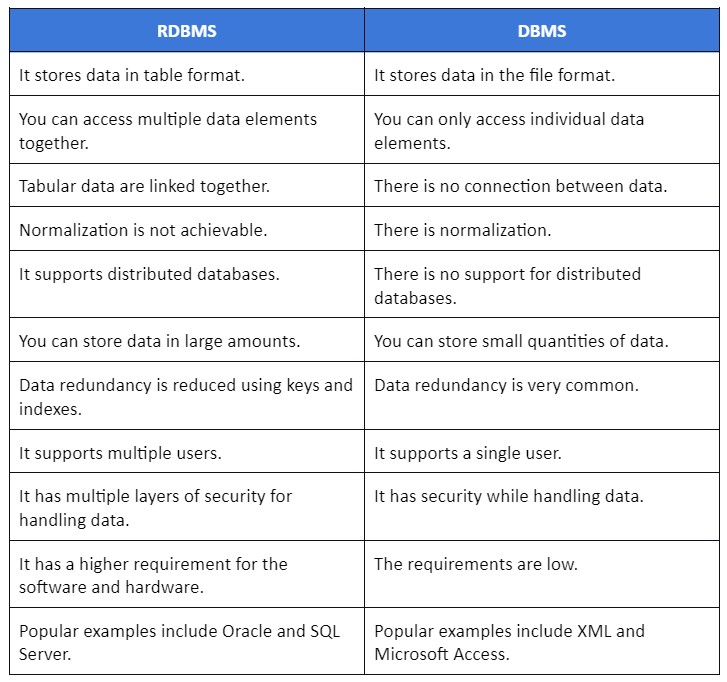
You must understand the difference between DBMS and RDBMS to acknowledge why RDBMS is gaining popularity and has become an important part of interview questions for various companies. The following table lists the key differences between the two.
To consolidate all that you have learned about relational databases, here is a list of the most commonly asked relational database technical questions for the interview.
This is one of the most commonly asked relational database interview questions. The relational database model defines the relationship among various databases and their connection. Thus, a relational model represents how data is stored. Some important terms for understanding the relational database model are:
ACID stands for the following four crucial properties that define relational database transactions:
Also read:Â Database Interview Questions.
Recruiters often ask relational database interview questions on data redundancy and ways to remove the same. Duplication of information is referred to as data redundancy. It is best to eliminate redundancy as far as possible because duplicate information wastes storage space and lowers the database integrity.
Normalization is a data organization process such that it minimizes redundancy. It involves the division of the database into multiple tables and defining logical relationships among them. The different normalizations are 1NF, 2NF, 3NF, 4NF, 5NF, BCNF, ONF, and DKNF.
Keys and their types are often a part of the relational database interview questions. A key is an attribute that helps identify a tuple/ row in a relation/ table. They establish relationships between different tables and columns. Each key has a key value. Following are the different types of keys in a relational database:
A data structure containing a copy of a column from a database table that increases the speed of retrieval operations on the original column in the table is called an index. The following are the main types of indexes:
You should be prepared for relational databases interview questions on data abstraction as they are amongst the most frequently asked questions. The process of hiding irrelevant details from users is data abstraction. There are three main levels of abstraction:
Oracle is always a part of relational database interview questions since it is the most popular RDBMS. It is popular because it has a fully scalable relational database architecture. Oracle database products grant customers high-performance and cost-optimized versions.
The Oracle database offers its own network component that allows communications across networks. Thus it has become the choice of top global enterprises that manage and process data across wide and local area networks.
Also read:Â Oracle SQL Interview Questions
The following database administrator interview questions will help you get familiar with the commonly asked questions you may encounter during an interview.
Also read:Â 50+ SQL Interview Questions and Tips on How to Crack Them
With Interview Kickstart you can fast track your interview prep, and nail any job interview. Led by industry experts (from the likes of Google, Facebook, and LinkedIn), our instructors will help you build a strong foundation in the subject, and give you all the tools required to be successful in your career and land your dream job.
You can check out some of the success stories of our alumni who have advanced their careers with the help of Interview Kickstart.
To prepare for relational database interviews, you must get familiar with the types of questions asked during the technical interview rounds. There can be questions about defining a term, differentiating, elucidating functions, and solving or writing queries.
If you are gunning for a job as a Database Manager, Data Analyst, Data Scientist, Information Security Analyst, Database Administrator, Data Modeler, or any other Software Engineering position, you should practice relational databases interview questions.
Top tech companies’ most popular relational databases are Oracle, MySQL, SQL Server, PostgreSQL, and SQLite. Facebook uses MySQL as the primary database for storing all the social data, and Amazon prefers Oracle.
Recruiters put across challenging relational database interview questions to gauge your hard and soft skills effectively. You must possess DBA skills, backup, recovery, and proficiency in Scripting/Automation like Perl, Database tools, and OS (Linux/UNIX/Windows/zOS). Thorough knowledge of SQL is also a must.
The average salary of Database Administrators is $90,199 per annum. While the best-paid 25 percent makes up to $126,890 per year, the lowest-paid 25 percent makes approximately $71,900 per year on average.




Time Zone:



Time Zone: