

Designed and taught by FAANG+ engineers, this course will give you a foolproof preparation strategy to crack the toughest interviews at FAANG and Tier-1 companies.

Covering data structures, algorithms, interview-relevant topics, and career coaching
Technical coaching, homework assistance, solutions discussion, and individual session
Live interview practice in real-life simulated environments with FAANG and top-tier interviewers
Constructive, structured, and actionable insights for improved interview performance
Resume building, LinkedIn profile optimization, personal branding, and live behavioral workshops
If you do well in our course but still don't land a domain-relevant job within the post-program support period, we'll refund 50% of the tuition you paid for the course.*

Attend online live sessions
1
2
3
4
5
1
2
3
1
2
3
4
5
6
7
1
2
3
1
2
3
4








1
2
3
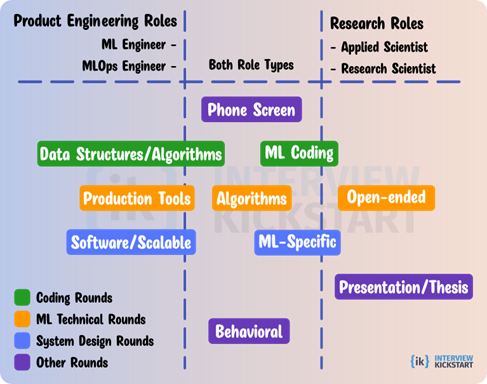
1 coding round – Usually includes questions on Data Structures and Algorithms, but some companies ask to code basic ML algorithms (Python)
1 ML system design round – Mainly focused on ML understanding (compared with the MLE round, where model production and deployment are equally important), i.e., identifying a suitable dataset for the problem, feature engineering, tradeoffs, sampling, etc.
1-2 ML Depth and Breadth rounds: Deep dive into ML fundamentals about their prior experience
1 coding round – Usually Python library-based (Pytorch/Tensorflow) or LeetCode Easy in some companies.
1 ML problem-solving round – Identifying a suitable dataset for the problem, feature engineering, tradeoffs, experimentation design, how to establish a baseline, modifying current algorithms to suit the situation, etc.
1 presentation round – Present some research problem (from the Ph.D. thesis, previous work experience, or any new topic relevant to the interviewing team), followed by QnAs. Expected to have a firm grasp of Concepts and Advancements in the given problem to answer applied questions.
1-2 ML Depth and Breadth rounds – Deep dive into ML fundamentals about their prior experience. Expected to have proficiency in ML Algorithms from the mathematical to the application level.
1
<div>Given a tree, write a function to return the sum of the max-sum path which goes through the root node.</div>
2
<div>Write a program to retrieve log data in an optimal way.</div>
3
4
1
Identifying the specifications for a scalable Machine Learning model for a specific business requirement
Extracting critical insights from historical data by leveraging data-wrangling expertise
Analyzing the use cases of ML algorithms and ranking them by their success probability
Finding the best models to balance business requirements and architectural constraints
Designing the high-level architecture required to deploy a production scale model on a given platform
Identifying differences in data distribution that could affect model performance in real-world situations
Automating model training and evaluation processes
Addressing various bottlenecks in scaling ML models to real-time customers with minimum latency and high throughput
Collaborating with data scientists and engineers to scale prototype solutions and build extensible tools
Monitoring model performance on different datasets under different architectural constraints
Designing and implementing APIs, services that host these models, and integrating said services to various endpoints
Leveraging AWS (e.g., Sage Maker, Lambda, etc.), Azure, or Google Cloud Platform with other techniques (e.g., Spark, Python, Java, etc.) to deploy production class ML services
Maintaining a highly scalable data and model management infrastructure that supports cutting-edge research
Maintaining core system features, services, and engines
Contributing to documentation and educational content for knowledge transfer
Training and retraining ML systems and models as needed
Building a suitable product feature roadmap by collecting current and future requirements
Adapting existing algorithms to make use of parallelized or distributed processing systems (e.g., distributed clusters, multicore SMP, and GPU)
You will work on more and more of the above tasks as you progress in your career as an ML Engineer. However, if you transition into a managerial role, you can also expect to:
Interact directly with customers to understand their requirements and drive changes to product features
Advise and collaborate with cross-functional teams, including researchers, data scientists, and data engineers, to improve architecture, design, and technical capabilities
Identify new products and opportunities for the company and influence the relevant stakeholders to prioritize their development
Develop and manage metrics, KPIs, and dashboards to improve team efficiency and ensure conformation to best practices
Understand industry-wide trends, and collaborate with industry experts to further organizational goals
Effectively communicate complex features & systems in detail
2
3
Bachelor’s degree or Master’s degree in Computer Science or related field
Experience building large-scale machine-learning infrastructure
Experience with at least one modern language such as Java, C++, or C#, including object-oriented design
Hands-on experience deploying Machine Learning models in production
Experience with Machine Learning techniques such as pre-processing data, training, and evaluation of classification and regression models, and statistical evaluation of experimental data.
4
US$185K
US$123K
US$40K
US$15K
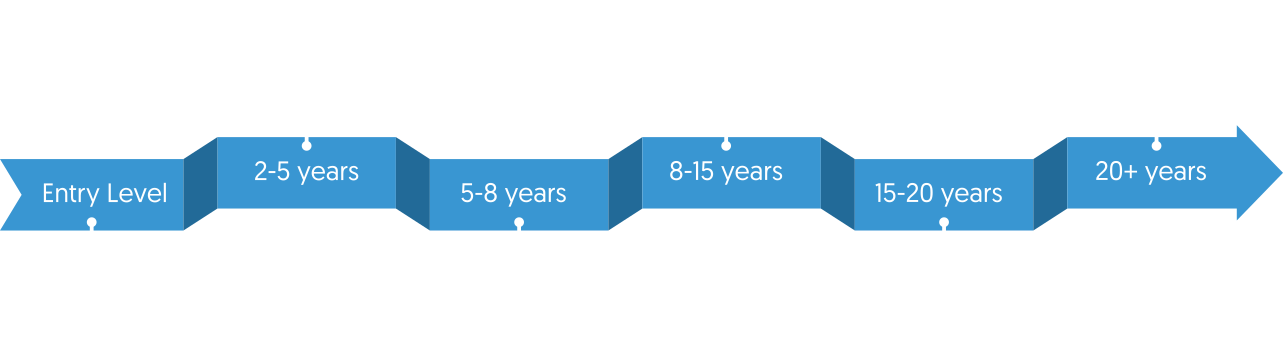
At the helm of today’s Machine Learning innovation is Google. So when the company sets out to hire Machine Learning engineers, you know they are looking for only the best of the best. The typical entry-level Google Machine Learning Engineer’s salary is $196K per year.
What are the programming languages used in Machine Learning?
Is having a mathematics background a must for ML-related roles?
Do ML Engineers perform ML modeling/experimentations, or are they just concerned with the deployment part?
Is IK’s Machine Learning Interview Course just for professionals working as ML Engineers in non-FAANG+ companies?
I am working as a Data Scientist in my current company. Will this course help me transition into an ML Engineer role?
Is this Machine Learning Interview course suitable for freshers?
Why do we need to learn Scalable System Design concepts for an ML Engineer interview?
How hard are the coding questions asked in ML Engineer interviews?

The 11 Neural “Power Patterns” For Solving Any FAANG Interview Problem 12.5X Faster Than 99.8% OF Applicants
The 2 “Magic Questions” That Reveal Whether You’re Good Enough To Receive A Lucrative Big Tech Offer
The “Instant Income Multiplier” That 2-3X’s Your Current Tech Salary
The 11 Neural “Power Patterns” For Solving Any FAANG Interview Problem 12.5X Faster Than 99.8% OF Applicants
The 2 “Magic Questions” That Reveal Whether You’re Good Enough To Receive A Lucrative Big Tech Offer
The “Instant Income Multiplier” That 2-3X’s Your Current Tech Salary
Just drop your name and email so we can send your Power Patterns PDF straight to your inbox. No Spam!
By sharing your contact details, you agree to our privacy policy.
Time Zone: Asia/Dhaka

We’ve sent the Power Patterns PDF to your inbox — it should arrive in the next 30 seconds.
📩 Can’t find it? Check your promotions or spam folder — and mark us as safe so you don’t miss future insights.
We’re hosting a private session where FAANG insiders walk through how they actually use these Power Patterns to crack interviews — and what sets top performers apart.
🎯 If you liked the PDF, you’ll love what we’re sharing next.


Time Zone: